

stylist walks into her first day at a new salon. She's talented. She's hungry. She asks her manager: "What does growth look like here?"
The answer, at many salons, is silence. Or something vague about "senior stylist" — a title that comes with a slight bump and zero change in trajectory.
We heard that silence for years. Then we decided to build something that actually answers the question.
The ceiling problem
The salon industry runs on a model that hasn't fundamentally changed in decades. Assistant. Stylist. Senior stylist. Done. The path ends, and when the path ends, people leave. They rent a booth. They go independent. They chase autonomy because we never gave them a reason to stay.
We don't blame them. If the only options are plateau or leave, leaving makes sense.
But we wanted a third option: what if there was a system where progression was transparent, compensation scaled with mastery, and every level unlocked something new?
How it works
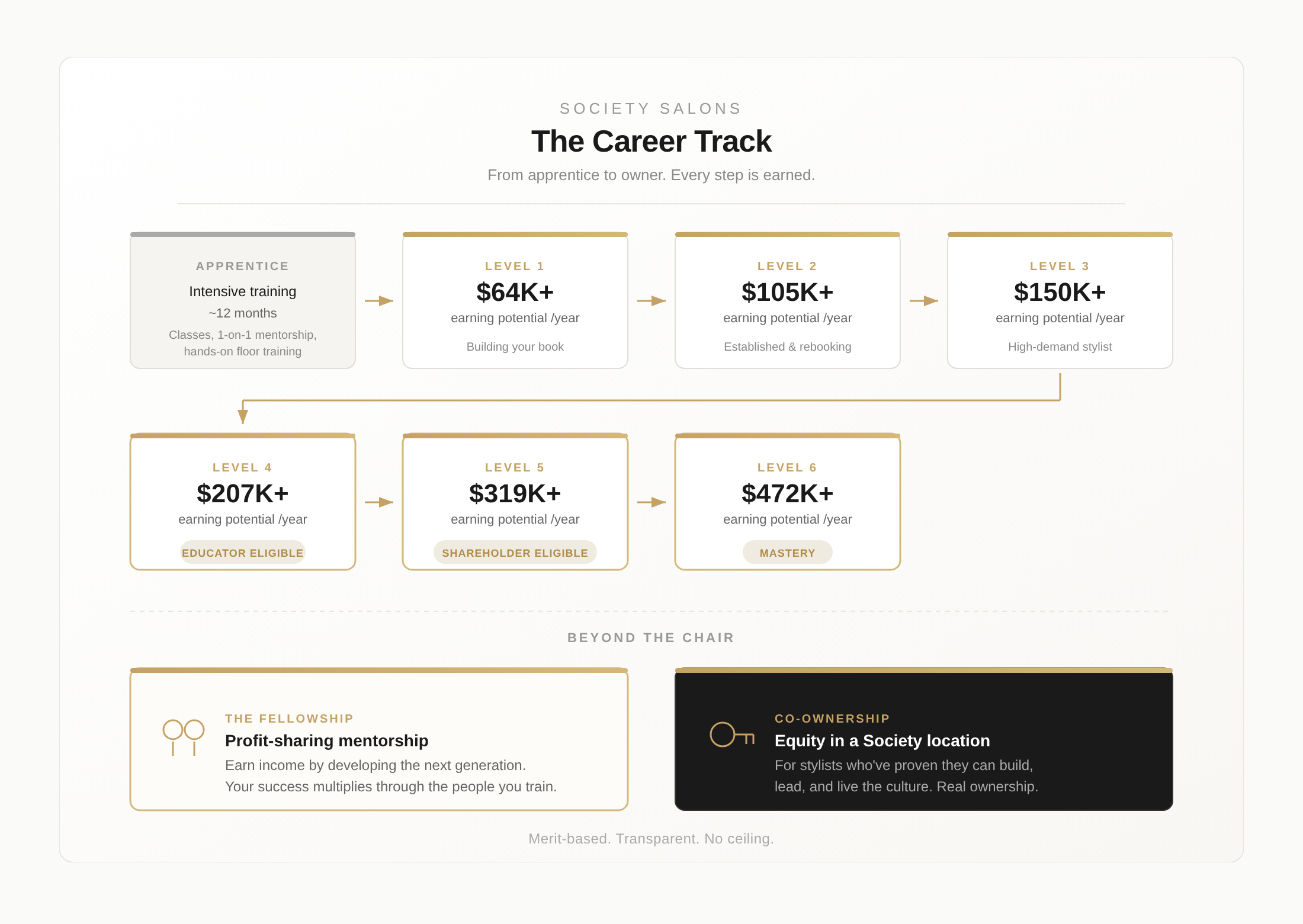
Every stylist at Society operates within a structured, merit-based career track. No guessing. No politics. No waiting for someone to decide you're ready. You hit four benchmarks — service revenue, rebook rate, referrals, and retail — for three consecutive months, and you advance. Period.
Each level comes with higher commission, expanded education access, and new responsibilities. The benchmarks increase as you move up, because the work should get harder as you get better. By the time a stylist reaches the upper tiers, they're generating serious revenue and operating with genuine autonomy.
The transparency matters. When you know exactly what the target is, you can build toward it. When advancement is opaque — when it's based on tenure or favoritism or just "feeling ready" — talented people stop trusting the system. We wanted a system worth trusting.
What the data shows
We invest roughly $20,000 in every apprentice we bring in. That's education, mentorship, payroll during the learning phase, product, time. It's not charity — it's capital allocation.
The stylists who've come through our system and stayed at least 12 months have all hit six-figure annualized revenue pace. The median time to get there? Three months. Not years. Months. That's not luck — that's what happens when you pair structured training with real accountability and a mentor who's invested in the outcome.
We've also learned where the system has gaps. Not every apprentice makes it. Some leave before the 12-month mark for reasons that have nothing to do with the program — life happens, LA is expensive, priorities shift. We don't count those in our success metrics, because that would be dishonest. What we can say is that the ones who commit to the full cycle ramp faster than anything we've seen in the industry.
The mentorship piece
Training without mentorship is just theory. Every new stylist at Society is paired with a proven mentor — someone who's already navigated the levels and knows what it takes to advance.
Here's what makes it different: the mentor earns a share of the mentee's revenue as they grow. It's a profit-sharing model — not a favor, not a soft assignment, but a real economic relationship. The mentor is invested because their income depends on the mentee's success. The mentee gets direct, daily access to someone who's already solved the problems they're facing.
This alignment changes everything. Mentors don't just show you a technique and walk away. They're coaching you through consultations, helping you build your book, troubleshooting your weak spots, and pushing you toward the next benchmark — because when you level up, they benefit directly.
Education isn't a perk — it's infrastructure
Every stylist gets education budget and dedicated time. Color theory. Advanced cutting. New techniques. Product innovation. Consultation skills. It's not optional.
The moment a stylist decides they know enough is the moment the work starts to suffer. Craft doesn't have a finish line. The best stylists we've worked with are the ones who treat education like training — ongoing, serious, and non-negotiable. We build that expectation into the structure so it doesn't depend on individual motivation.
Beyond the chair
The career track doesn't stop at commission tiers. We're building pathways that extend into mentorship income through our fellowship program, and ultimately into co-ownership — where a stylist who's proven their ability to develop people and hit metrics can own equity in a Society location.
That's the real answer to the ceiling problem. It's not just about paying more at each level. It's about creating a trajectory that goes somewhere meaningful — from apprentice to stylist to mentor to owner. A genuine career arc in an industry that's never really had one.
Why this matters
If you're a stylist reading this, you already know the feeling. You've hit a wall somewhere. You're good at what you do, maybe great, and the path forward is... unclear. You're weighing booth rental. You're wondering if this is it.
We built this system because we believe it doesn't have to be. The industry has been losing its best people because we haven't given them a compelling reason to stay. Not a guilt trip. Not a loyalty speech. A real, economic, structural reason.
That's what structured advancement is. Not a perk. Not a poster on the wall. A system that rewards mastery, invests in growth, and actually goes somewhere.
We're still building. We're refining how we measure, how we compensate, how we develop the people who make this place what it is. But the foundation is set — and for any stylist who's been looking for a place where the path is clear and the ceiling doesn't exist, that's what we're building at Society.
If this sounds like the place you've been looking for, apply now.


